In cosmetics, daily chemicals and related fields, there is a class of nonionic surfactants that have always occupied an indispensable position. It is the “Tween series” in the industry.The common English name of the Tween series is Polysorbate, and the transliteration of Tween, due to its long-term widespread use, this common name has become a conventional name in the industry, which is simple, easy to remember and highly recognizable.
From the point of view of the INCI system, the naming of the Tween series has a clear pattern. They are all prefixed with “polysorbate” and suffixes with numbers (such as 20, 40, 60, 80, 85, etc.). Therefore, it is customary in the industry to call them polysorbate 20 (Tween 20), polysorbate 40 (Tween 40), polysorbate 80 (Tween 80), etc. Different numbers correspond to different product characteristics and adapt to different formula requirements.As a classic
Oil in water emulsifier, the Tween series is widely used in many fields such as cosmetics, personal care, washing and daily chemicals due to its core advantages such as gentleness, stability, and strong compatibility.
Tracing back to the basic definition and source of the Twain series, its essence is polyoxyethylenated sorbitan fatty acid esters, which is a composite structure formed by the polymerization of three core components through chemical reactions. Each component determines its final performance.The first is Sorbitol, which is dehydrated to produce Sorbitan, which is the basis for the molecular skeleton of Twain.The second is fatty acids. Different types of tween use different sources of fatty acids, such as lauric acid, palmitic acid, stearic acid, oleic acid, etc. This is also the core key to distinguish different tween models.Finally, ethylene Oxide forms a polyoxyethylene chain through the addition reaction, which gives Tween good hydrophilicity. The three work together to form a Tween series of products with multiple functions such as emulsification, co-dissolution, and dispersion.
From the perspective of formula application, the core characteristics of the Tween series are very prominent, which is also its core competitiveness that can occupy the market for a long time.As a nonionic surfactant, the most significant advantage of the Tween series is that it is not charged. This characteristic gives it three major advantages: first, it has good compatibility, can be compatible with cationic and anionic surfactants and various active ingredients, and there is no need to worry about the stratification, precipitation and other problems of the formula, which greatly reduces the difficulty of formula development.The second is that it is not sensitive to electrolytes. Even in formulas containing electrolytes such as salts and minerals, stable performance can be maintained, and the emulsification and dissolution effects will not be affected by the presence of electrolytes.Third, it has excellent gentleness and low irritation. It is not only suitable for ordinary cosmetics and personal care products, but also for sensitive skin products and child care products.
High HLB value (hydrophilic and oleophilic equilibrium value) is another core characteristic of the Tween series. Its HLB range is usually between 10-18, which is a typical O/W
Emulsifier.This characteristic determines that the Tween series is more suitable for the preparation of O/W emulsions. It can evenly disperse oily ingredients in the aqueous phase system to form a delicate and stable emulsion-like product. This is also the key reason why it is widely used in creams, lotions, makeup remover and other products.At the same time, the high hydrophilicity also makes the Tween series have excellent solubilizing ability, especially suitable for the solubilizing of flavors and essential oils, which can easily achieve the transparent dissolution of essential oils, making the formula of transparent shampoos, moisturizing sprays and other products easier to achieve.In the actual formula, when the Tween series is used in combination with
Cyclopentasiloxane, it can further enhance the skin feeling and stability of the product, and realize complementary advantages.
The good dissolution and dispersion capabilities have further broadened the application scenarios of the Tween series.In addition to the solubilizing of flavors and essential oils, the Tween series can also effectively disperse active ingredients, such as vitamins, plant extracts, etc., to ensure that these functional ingredients are evenly distributed in the formula, give full play to their effects, and avoid product effects due to component aggregation.At the same time, it can also improve the stability of the flavor and oil system, prevent the product from stratification, odor and other problems during storage, and extend the shelf life of the product.In addition, the Tween series also has a certain thickening effect, which can moderately adjust the viscosity of the product, so that the texture of the product is more in line with consumer habits, whether it is a spray with strong fluidity or a cream with a viscous texture, the ideal texture state can be achieved through the adjustment of the Tween series.
In the Tween series, different models of products have obvious differences in their characteristics and application scenarios due to different sources of fatty acids. Among them, polysorbate 20, polysorbate 40, polysorbate 60, polysorbate 80, and polysorbate 85 are the representative products of our Tween series. The core information of these five large models is as follows:
Polysorbate 20, using lauric acid as a source of fatty acids, has a yellow transparent liquid appearance, is a 1-3 green and environmentally friendly raw material, and the packaging specification is 25kg/drum.The core feature of this model is its high hydrophilicity and outstanding solubilizing ability. It is especially suitable for the solubilizing of flavors and essential oils. It is widely used in transparent shampoos, moisturizing sprays, essence water and other products. It can quickly dissolve oily flavors and give the product a transparent and refreshing appearance. At the same time, it can enhance the gentleness of the product and reduce skin irritation.In the formula, for example, it can be used in combination with
SODIUM ACRYLOYLDIMETHYL TAURATE COPOLYMER to further improve the stability and skin feel of the product.
Polysorbate 40, with palmitic acid as the source of fatty acids, has the appearance of a yellow viscous liquid. It is also a 1-3 green and environmentally friendly raw material. The packaging specification is 25kg/drum.Its emulsifying ability is medium, and its hydrophilicity and oleophilicity are relatively balanced. It is suitable for medium-viscosity emulsions, creams and other products. It can help form a delicate and stable O/W emulsion, and it can also be used in washing products.
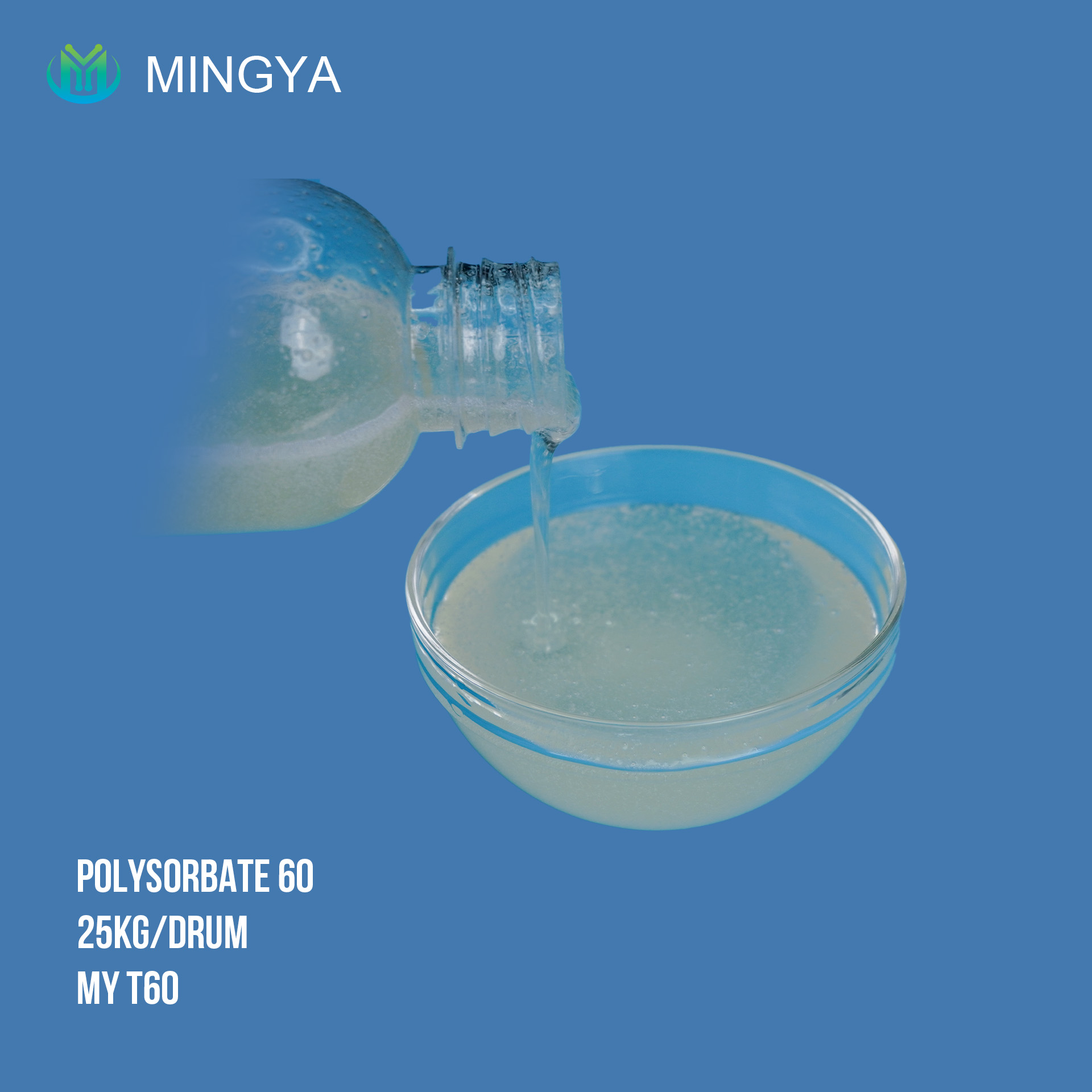
Polysorbate 60, using stearic acid as a source of fatty acids, has the appearance of a yellow viscous liquid, 1-3 green and environmentally friendly raw materials, and the packaging specification is 25kg/drum.Its core advantage is that it has excellent stability and strong emulsifying power. It can maintain a stable emulsifying effect over a wide temperature range. It is not easily affected by temperature and pH value. It is suitable for products that require high stability requirements, such as face creams, body creams, hand creams, etc.
Polysorbate 80, with oleic acid as the source of fatty acids, has a yellow transparent liquid appearance, 1-3 green and environmentally friendly raw materials, and a packaging specification of 20kg/drum.Its biggest feature is its strong oil-dissolving ability, which is more suitable for the formula of oily systems, and can easily emulsify high-content oily ingredients, such as mineral oils, vegetable oils, etc., and is widely used in makeup remover oils, makeup remover water, oily face creams and other products.
Polysorbate 85, the source of fatty acids is trioleic acid, the appearance is amber liquid, 1-3 green and environmentally friendly raw materials, and the packaging specification is 25kg/drum.It has relatively strong oleophilicity and excellent emulsifying ability. It is suitable for formulas with high content of oily ingredients, such as heavy creams, body creams, conditioners, etc.
Relying on multiple core advantages, the Tween series has a wide range of applications. Among them, cosmetics/personal care and washing and home cleaning are its two core application scenarios. At the same time, it also has important applications in medicine, food and other fields, and the market demand continues to be strong.In the field of cosmetics/personal care, the Twain series covers almost all kinds of products, from basic lotions and creams, to cleansing makeup remover and cleansing products, to shampoo and conditioner for hair care. You can see it.
In the field of washing and home cleaning, the core role of the Tween series is to disperse flavors and improve formula stability.In household detergents, softeners and other products, flavors are an important ingredient to enhance product competitiveness, and the Tween series can evenly disperse flavors in the aqueous formula to avoid problems such as uneven aroma and stratification caused by flavor aggregation.In addition, the Tween series can also improve the stability of detergent formulas and enhance the decontamination ability of products. It is especially suitable for mild detergents to reduce the irritation of surfactants to the skin and the environment.In practical applications, the Tween series is combined with
Bis diglyceryl polyacyladipate 2 to further optimize the texture and use effect of washing products.
Overall, the Tween series, as a class of high HLB, nonionic, polyoxyethylene surfactants with solubilization and O/W emulsification as their core functions, has a clear definition, clear model differences, excellent product characteristics and a wide range of application scenarios.


 Hubei Mingya New Material Technology Co., Ltd.


